Learn2Volunteer is a free multilingual e-learning and mentoring platform designed to strengthen the skills, knowledge, and engagement of young volunteers. The platform provides interactive online courses, mentoring opportunities, digital badges, and certificates that support volunteers throughout their learning and volunteering journey. It covers topics such as leadership, communication, project management, fundraising, digital literacy, active citizenship, volunteering, and community engagement. Developed through a collaboration of organizations from Greece, Italy, Türkiye, Lebanon, Jordan...
This policy brief was developed as a deliverable in the project “Fair Game: Theatre of the Oppressed for Youth Empowerment” funded by the European Union. It tackles the topic of bullying in schools and offers recommendations drawn from the field experience in Lebanon that focused on the methodology of Legislative Theatre to raise awareness on bullying in schools and advocate for better policies.
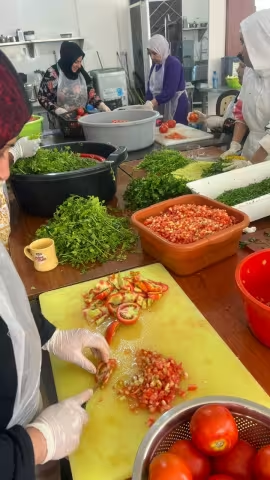
In the wake of Lebanon’s compounded humanitarian crisis, the Community Kitchen Initiative emerged as a localized, life-saving response to ensure that food-insecure populations had access to hot, nutritious, and culturally appropriate meals. Operational since March 2025 till present, this intervention served as a vital daily service across Nabatiyeh, South Lebanon, Mount Lebanon, and Baalbek-Hermel. Led by SPHERE Building Tomorrow (SBT), the project leveraged community-based kitchens and volunteer networks to deliver food assistance while promoting livelihoods and strengthening local food...
Findings in the "Analysis on Stunting Among Syrian Refugee Children" showed that risk factors perceived to be contributing to stunting levels among Syrian refugee children included those at the individual and household level with poor maternal nutrition, household food insecurity and inadequate complementary feeding practices as the factors perceived to be contributing the most to stunting among Syrian children. On the other hand, at the institutional and community level, market food prices, poverty, income, employment and livelihoods were the factors perceived to be contributing the most to...
This project aims to (1) bring statistical transparency to youth’s opinions, attitudes, feelings, and perceptions about social, cultural, political, and familial freedom of speech barriers within our society, and find what activities facilitate youth’s freedom of speech; (2) create discussion and widespread accountability by engaging the online and offline community, institutional stakeholders, and youth though an advocacy Call to Action based on our research findings, and (3) provide evidence that creative civic spaces are an integral part of our community and change negative attitudes...
CONCLUSION AND RECOMMENDATIONS
This policy brief examined the complex trajectories and mechanisms of the intervention deployed in the aftermath of the explosion raising questions of fairness and equality to the forefront of the humanitarian regime in Lebanon. Based on results yielded from fieldwork, we recommend the following:
Launching a consortium of CSOs, fourth sector civil society, and government representatives in order to set out a coordination scheme among humanitarian players for future crises. CSOs, fourth sector organizations in collaboration with the Ministry of Social Affairs are...